Is Historical Progression a Useful Scaffold?
Can subjects be taught in the order that they were developed so that students’ understanding of the subject advances in line with the development of the field? Further, does the order in which human knowledge is gained at large parallel the best sequences to teach a subject? Thus, a student’s mathematical knowledge grows from solving the same real world problems that led to math’s development (navigation, construction, physics) and the arts are taught against the political and social background of their creation.

Can History Serve as the Foundation for an Integrated Curriculum?
All knowledge we teach in school was discovered in the past. So can we base all that we teach in the historical context in which it was learned? This has the benefits of situating lessons in a holistic human history where math, science, politics, art, engineering, literature, and religion all intersected and interacted with one another. With a bedrock of history, the core classes of Language Arts (Humanities), Math, Science, and History (Social Sciences) can all inform each other.
How can we Simulate Authentic Problems within a Long Term Curriculum?
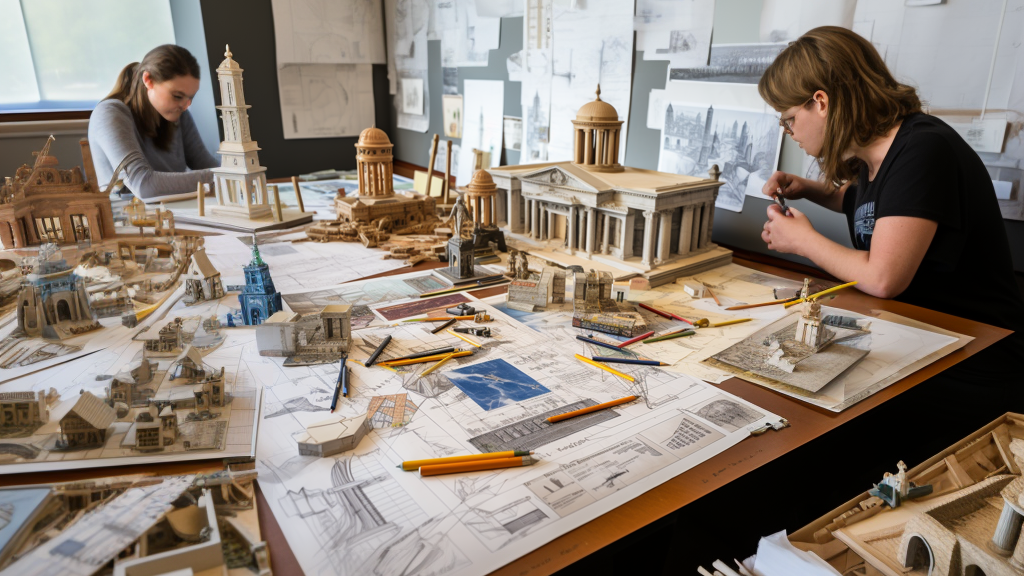
I am interested in converting real world problems that took ingenuity, practice, and patience to solve that led to advances in human knowledge and capacity into projects for students to work on and solve with their own creative capacity. I then want to develop an overarching, historical curriculum in which these problems fit. My dream is to create opportunities for students to reconstruct geometry and calculus (while programming their own calculators), to reenact and write their own plays, to make their own decisions about peace and war, and to construct their own wonders of the world.
How can we Embed Projects and Assessments into a Game System?
Games are an excellent way of simulating the rich, holistic, and interconnected world I am hoping to prepare our students for. Too often school is disconnected from reality and imposes false boundaries between subjects. I see games as an excellent way to not only motivate and excite students, but to connect math and politics and art and science. I’ve created character sheets and game systems which incorporate student work into the development of student-enacted heroes and civilizations. The goal being to reify student learning and growth in ways that students can see, manipulate, and play with.
 The Course of History