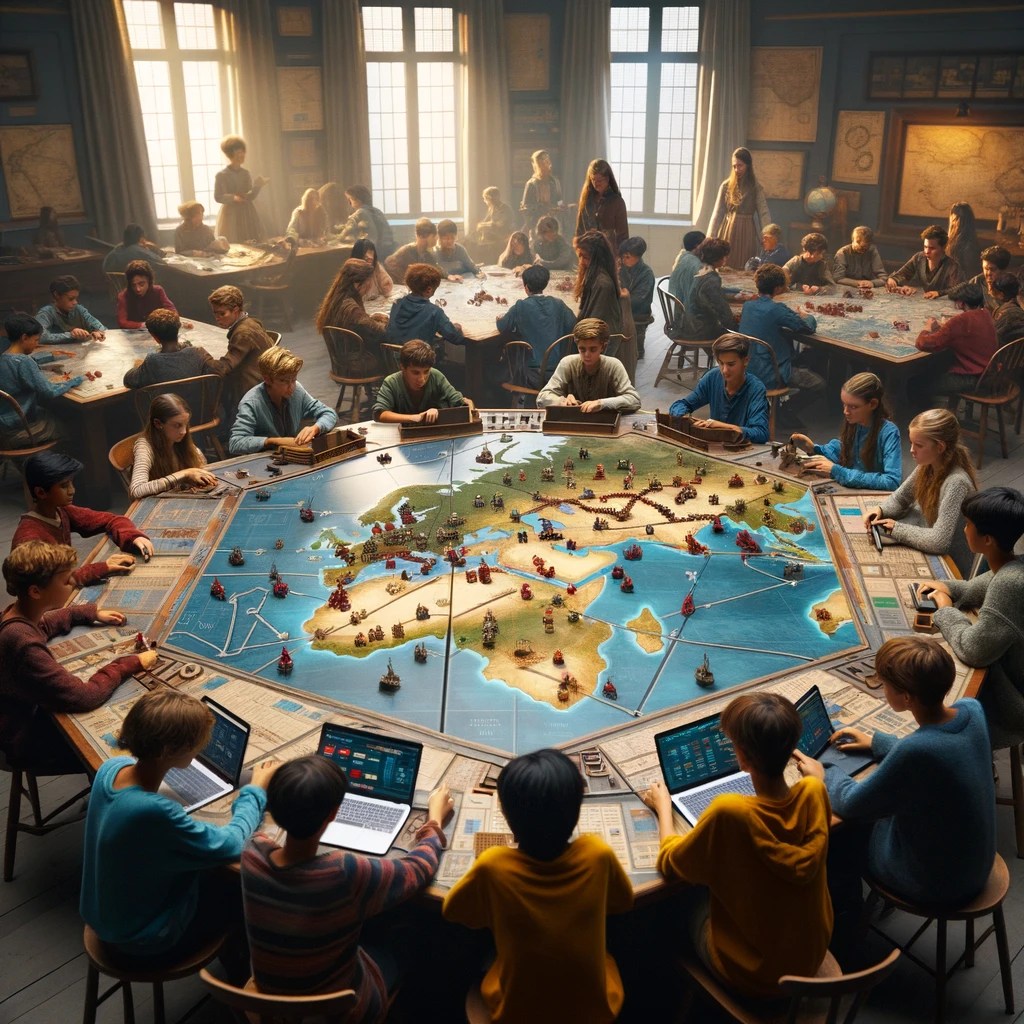
Overview:
While many in-class games and simulations last for a short period of time (from a single class period to a week or two), my focus is on simulations that structure an entire course at the semester or yearlong level. The idea is that this compounds the benefits to students, eliciting greater immersion, motivation, and interest in the course. I’ve found that being able to make consequential decisions has extraordinary benefits on student engagement and understanding of the cause and effect relationships in class.
Students engaged in simulation games are more actively engaged and learn history as a living and lived experience, not a dead story. Students interact with the complex systems at play like finance and economics or political persuasion leading to better, deeper understanding. Finally, the problems engage them in social play at a high level. They take on roles in high stakes situations and learn to work with one another in new and interesting scenarios.
Classroom Management and Structure
Simulations have a huge potential for fun, deep learning. But they also carry the risk of chaos and failure. It’s important to collaborate with students to consistently improve and manage expectations. Things will go wrong, but that presents an excellent opportunity for student feedback and buy-in. Simulations, especially in history, have a lot of moving parts reflecting real world systems. Delegate tasks to students and ask them how to improve how the simulation models the real world. Not only will this improve the flow of the game, but it will also engage them in better conceptual understanding of the world systems at play.
Unlike typical classrooms, much of the time should be spent with students working independently of teacher leadership. This might be in small groups negotiating or strategizing, individually working on projects, or otherwise self-directed. The beauty of simulations is that students have tangible, meaningful objectives that motivate them to work. This is a time for teachers to take a step back from the head of the classroom and instead confer with students individually. The classroom might get a little rowdy, but give them some space to get creative and messy (within reason).

Rules
In my simulations, I like to keep the rules as simple as possible to allow for maximal creativity on the part of the students. The main components of the rules are the actions students can take and the method of resolving the success of those actions. In the top down strategy simulations, I typically limit actions to movement, attacking, and negotiating which allows for alliance building. Both attacking and negotiating rely on competitive dice rolling where students roll a dice determined by their strength in-game.
As I discuss in the next section, the more work students do, the better their chances of winning these dice rolls. In brief, homework leads to points and points determine the number of sides of a dice they get to roll. You can use real dice or a random number generator. Imagine a battle between two students. Student A has turned in 15 pages of work this semester could either “roll” a random number generator between 1-15, or roll a 10 sided dice plus a 4 sided dice. Student B has turned in 20 pages, and could roll a 20 sided dice or use a random number generator as well.
The outcomes can either be binary or cumulative. In a binary system, whoever gets the higher dice roll wins the combat. In a cumulative system, students deal damage to each other until one student can no longer fight. Each student has a certain army strength which can be determined by work completed, geography controlled, etc. When student A rolls an 8, they deal 8 damage to Student B’s army. Student B has an army size of 15 (based on work completed and cashed in for their army size), and so has 7 more “troops” available for combat after this turn.
Student Projects, Grades, and In-Game Rewards
Fundamental to this is the bridging of student work with the systems in the simulated world. Rather than abstract, extrinsic grades, I think it’s important to make rewards and feedback integral to the play and progression of the game. In my Ancient Greece class, the main systems were economics, politics, and military. Student projects directly translated into increasing their abilities in each of these categories: their work could improve their military acumen, increase their army size, establish trade relations and treaty alliances and much more. A paper might take the form of a speech given to a neighboring city-state and result in a higher likelihood of an alliance; an art project might show a student character with a new technology, giving them a bonus to military rolls.

Student work might have direct results in game, like a treaty or constitution that would shape game mechanics. But I also replaced grades with student character power. The amount of work students put into their projects was reflected by their points in their Political, Economic, and Military ability. When making an action, they would roll a dice equivalent to their relevant score. For example, students started off with a base score, say ten, and a particular student had written 15 pages about the military that semester. When she went to attack an enemy army, she would use a random number generator from 1-25 and do that much damage to her opponent. Similarly, income each turn was dictated by how much work they’d put in.
Characters & Roles
Based on the scale and scope of the course, you should determine what roles you want students to play. There are many options to choose from:
- Individual Characters
- Families & Dynasties
- City Governments
- Organizations
- Large Governments (Kingdoms, Empires, Nation States)
- Large deliberative bodies: Congress/Parliament, UN, etc.
 The Course of History